Most people around here treat salt air as a paint problem. You see it on the porch railing, on the grill, on the trailer hitch that went white and chalky after one summer near the water. So you wash the car, you wax it in the spring, and you figure you have done your part.
Paint is the half you can see. The half that actually strands you is hardware: the valve stem in your wheel, the lug studs, the pins that let your brake calipers slide, the steel lines under the floor pan. None of that gets waxed, and most of it never gets looked at unless somebody has the wheels off.
If your vehicle lives within a few miles of the Indian River Bay, or you drive the Rehoboth and Lewes corridor every day, this is worth ten minutes of your attention.
Why Coastal Sussex County Is Harder on Hardware Than the Odometer Suggests
Cars around Millsboro, Long Neck, Dagsboro and Georgetown get hit from two directions.
The first is year-round. Salt-laden air blows off the bay and the ocean and settles on everything. Research on atmospheric corrosion is blunt about how much your address matters: the harshest corrosivity classification used by engineers shows up only very close to the water, generally under two kilometers from the shoreline and in most cases under half a kilometer to a kilometer. Chloride fallout drops off sharply inland, falling to less than half the high-salinity threshold by about two and a half kilometers from shore.
So a truck parked in Long Neck or Dewey lives in a harsher environment than the identical truck sitting ten miles west, even if they drive the same roads. Nothing on the dash tells you that.
The second source is winter. DelDOT pretreats roads ahead of storms with brine, a liquid mixture of 23 percent rock salt and 77 percent water, because it takes four times less salt to keep ice from bonding to the pavement than to clear it afterward. Good road strategy, and also a chloride bath sprayed across the exact undercarriage parts nobody inspects.
Put the two together and you get the defining feature of salt air car corrosion in Sussex County: it runs on the calendar, not the odometer. A retiree’s sedan in Millsboro that covers barely any miles a year still spends every one of those days marinating. A low-mileage vehicle here is not a low-wear vehicle.
The vehicles that get the worst of it
- Boat and trailer tow rigs. Backing down a ramp puts hubs, studs and brake hardware directly into salt water.
- Beach-corridor commuters. Clean, waxed, presentable, and completely unwashed underneath.
- Work trucks and fleet vehicles. Heavy exposure, long service lives, and hardware that has to come apart on schedule.
- Anything that sits. A car parked outside all winter collects deposits without the rinsing that driving in rain provides.
TPMS Valve Stem Corrosion: The Part That Breaks While It Is Being Serviced
Your tire pressure monitoring sensor lives inside the wheel and connects to the outside world through a valve stem. On a lot of vehicles that stem is aluminum, held to the wheel by a nut, with a valve core threaded into it. Both are exactly the kind of small threaded parts that salt destroys.
According to Tire Review, aluminum clamp-in stems are considerably more prone to corrosion than rubber ones, especially where the stem is regularly exposed to salt, sand, humidity or road grime. That is a fair description of every wheel in this county. Once corrosion starts, a chemical reaction bonds the nut and the valve core to the stem and warps the rubber sealing parts along with it.
The important part: the failure usually shows up during service, not on your dashboard. A tech goes to loosen the nut during a routine rotation, meets resistance, and the stem snaps at the nut. Tire Review notes that breaking the nut or valve core may be unavoidable once corrosion has set in. The part was already finished; touching it just revealed that.
So a rotation on a coastal vehicle can turn into a sensor conversation before the wheel goes back on. If that happens, ask the shop to show you the stem, and ask for a current quote on the replacement before any work continues.
What TPMS valve stem corrosion looks like
- Discoloration or physical damage on the part of the stem you can see outside the tire
- Crusty buildup around the valve core
- Corrosion under and around the nut where the stem meets the wheel
- A slow leak in one wheel with no nail, no cut, and no obvious puncture
The fix is procedure, not heroics
There is a boring answer here, and it works: replace the service kit every single time the tire comes off the wheel. Tire Review states that as best practice regardless of stem type, because the rubber grommet hardens over time and starts leaking after the tire is deflated and reinflated. A clamp-in kit typically includes the valve core, rubber grommet, plastic cap and torque nut, plus the aluminum stem and torque screw on replaceable models. Bartec USA puts it plainly: never reuse the existing components.
One more rule matters double in salt air. Rubber stems take brass valve cores; aluminum stems take nickel-plated cores. Brass and aluminum react to each other when exposed to air and humidity, so mixing them accelerates galvanic corrosion and can seize the core inside the stem.
Aluminum Wheels: The Corrosion You Cannot See Until the Tire Is Off
If you have one wheel that quietly loses a couple of psi a month, holds fine after you top it up, and never shows a nail, this section is about your car.
MOTOR Magazine describes the mechanism simply: water and air in contact with aluminum alloy create aluminum oxide corrosion. It forms around the lug holes and, more importantly, at the tire bead area hidden underneath the tire. Corrosion can sit in there long before anything appears on the face of the wheel. The bead is where the tire’s rubber has to seal against metal, and once that surface has gone rough and chalky, the seal is imperfect. Air walks out slowly.
You cannot diagnose that from the outside. The tire has to come off the wheel.
Why sealant is the wrong answer
The bottle of tire sealant is tempting, and it is a bad idea here. MOTOR is clear that sealant poured through the valve stem is not a permanent repair for a corroded rim leak, and it can interfere with the TPMS sensor sitting right there inside the wheel.
What proper repair looks like
With the tire dismounted, the corroded bead seat gets cleaned back to sound metal using emery cloth, surface conditioning discs, abrasive pads or wire wheels. The judgment call is knowing when to stop. Over-aggressive abrasion removes wheel material, and if corrosion has pitted deeply enough to distort the wheel’s radius, the tire may never seal properly again. Reapplying a clearcoat afterward at least delays the corrosion from coming back.
Sometimes the honest answer is that the wheel is past saving. That is a conversation worth having with the wheel in front of you, and a current quote from the shop covering both options.
Seized Studs, Frozen Slide Pins, and Wheels Stuck to the Hub
Wheels and stems are only where it starts. The same chemistry works on every fastener under the car.
Lug studs and nuts gall and seize. A stud that fights coming off is a stud that may break, and a broken stud is a repair, not an inconvenience.
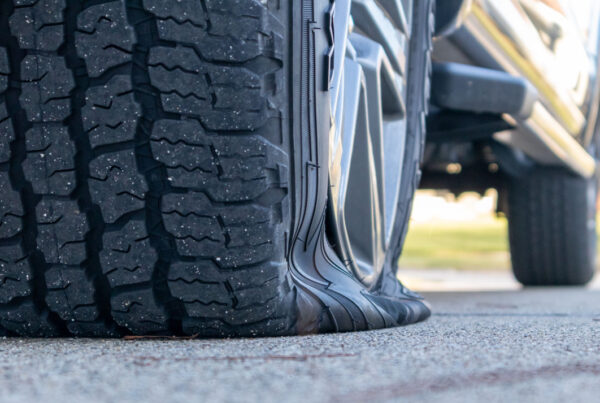
The wheel itself corrodes to the hub face. Aluminum wheel, steel hub, salt in between, and the two effectively weld themselves together. That is why a roadside tire change goes so badly on a coastal vehicle: the lug nuts come off and the wheel simply will not. Our step-by-step guide to handling a flat tire is a good companion read.
Caliper slide pins seize too. Those pins let the caliper float so both pads wear evenly. When one binds up, the pads on that wheel wear unevenly and the brake stops doing its share. The symptom is subtle, which is why it usually gets caught during a brake inspection rather than reported by the driver.
Under the Car: Wheel and Brake Line Rust in Coastal Delaware
Brake lines deserve a more serious tone, because a brake line does not warn you.
On April 9, 2015, after investigating 3,645 complaints of brake pipe rust that included 107 crash reports and 40 injury reports across roughly five million 1999 to 2007 GM pickups and SUVs, NHTSA closed the case without a recall and instead urged owners of 2007 and older vehicles in 20 salt-belt states and Washington, D.C. to have their undercarriages washed several times during and after winter and to have their brake lines inspected for rust and replaced if needed.
The recommendation is the point. Brake lines rust from the outside in, and there is no dashboard light for a line that is nearly through. What you might notice is fluid loss, an unexplained leak, or a pedal that feels soft or spongy. Flaking or scaling metal on the lines is the visual warning.
Exhaust hangers rust through in the same quiet way, and the result is a rattle, a dragging pipe, or a leak. Delaware’s safety inspection requires an exhaust system with no leaks and a muffler that effectively reduces engine noise, along with brakes that stop the vehicle within the required distance. Corrosion has a way of failing all three at once. If your registration is coming due, our post on what a Millsboro shop should look at before your Delaware inspection walks through the rest of the list.
What Your Shop Should Be Looking At While the Wheels Are Already Off
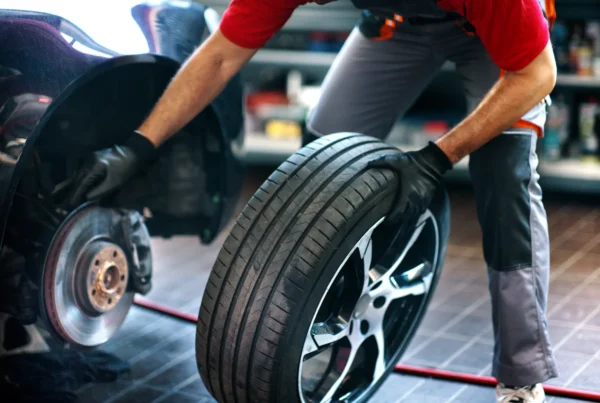
The wheels-off moment is the best inspection opportunity your vehicle gets all year, and you are already paying for it during a rotation or a brake job. This is what should get eyes on it:
- Valve stems for discoloration, damage, and buildup at the core and nut
- Bead seats, if a wheel is being dismounted anyway, for white chalky oxide
- The inside face of every wheel, which is where the salt actually collects
- Lug studs and hub faces for corrosion and galling
- Caliper slide pins for free movement, plus pad wear that is uneven side to side
- Brake lines end to end for flaking, scaling and damp spots
- Exhaust hangers and pipe seams for rust-through
That is not an upsell list. It is a look list. A corroded part found in September is a scheduled repair instead of a January surprise, and anything that does need work you will hear about with the part in hand, so you can request a current quote before anything gets ordered.
What You Can Do Between Visits
- Rinse the undercarriage, not just the paint. Use the underbody spray at the car wash, or a hose and a wand under there. This is the highest-value thing on the list, and the one NHTSA itself recommends.
- Rinse after beach trips and boat ramps. Salt water on hubs and brake hardware should not be left to dry there.
- Check tire pressures monthly, wheel by wheel. One wheel behaving differently from the other three is the signal.
- Do not chase a slow leak with sealant. Bring it in and let somebody look at the bead seat.
- Pay attention to the brake pedal. Soft, spongy, or slowly sinking is a reason to come in now rather than later.
- Listen underneath. New rattles, buzzes or drone at speed often mean a hanger has let go.
- Deal with it before inspection time. Corrosion-related failures rarely fix themselves on a deadline.
None of this requires you to become a mechanic. It requires the wheels to come off in front of somebody who knows what salt does.
Schedule an Appointment With Your Local Millsboro Tire Shop
If your vehicle spends its life within a few miles of the water, corrosion is not a maybe. It is a slow, quiet certainty working on your stems, studs, wheels and lines while the paint still looks great.
We are a full-service tire shop in Millsboro, DE, serving drivers from Long Neck, Dagsboro, Georgetown and the Rehoboth and Lewes beach corridor, and we have wheels off vehicles from this county constantly. We know what bay air does to a bead seat and what a boat ramp does to brake hardware, and we will tell you exactly what we find and why it matters. If a repair is needed, ask us for a current quote and you will get one before any work begins.
Schedule an appointment and let us take a look while the wheels are already off.