
There is a moment that catches a lot of drivers off guard, and it does not happen on the side of the road. It happens in the waiting room at the tire shop, when the tech says the tires are down to the wear bars and asks a question the driver has never had to answer before: do you want run-flats again, or do you want to switch to regular tires?
If your vehicle left the factory on run-flats, there is a good chance it also left the factory without a spare, without a jack, and without a lug wrench. That was not an oversight. The engineers deleted all of it on purpose, because the tire itself was designed to carry the car for a limited distance with no air in it. So the choice you make at tire time is bigger than it looks. It quietly decides what your car can do the next time it loses pressure.
This post is about that decision. Not what to do when you are already stuck on the roadside, but what to buy before you ever get there. We have this conversation constantly with drivers from Millsboro, Long Neck, Georgetown and the beach towns.
First, Confirm What You Actually Have
Plenty of people drive run-flats for years without knowing it. A few quick ways to tell:
- Look at the sidewall lettering. Tire makers each use their own shorthand. Bridgestone marks them RFT, Michelin uses ZP for Zero Pressure, Continental uses SSR, Goodyear has used EMT and ROF, and Dunlop has used DSST. If you see one of those codes near the size, you are on run-flats.
- Lift the cargo floor. A foam organizer, a small 12-volt compressor and a canister of sealant where a donut spare should be is a strong hint. So is the absence of a jack.
- Check the owner’s manual. Vehicles engineered around run-flats usually say so plainly, and usually give a distance and speed limit for driving on one that has lost air.
If you are not sure, any competent tire shop in Millsboro DE can read it off the sidewall in about a minute while the car is on the lift. Our advice on how to buy new tires still applies here, but run-flat vehicles add a decision most shoppers never see coming.
Run-flats are not exotic around here. Published industry references note that BMW became the largest original-equipment fitter of run-flat tires, with Bridgestone and Pirelli supplying them specifically as an alternative to carrying a spare, while Honda went the other way and discontinued them after 2009. The no-spare trend kept going with or without run-flats. AAA research found that nearly one-third, 28 percent, of 2017 model year vehicles came with no spare tire as standard equipment.
Option One: Stay With Run-Flat Tires
Staying with what the car came with is the simplest path, and there are real reasons to take it.
What you keep
You keep the mobility the vehicle was engineered around. Bridgestone states that its run-flat tires allow driving up to 50 miles at speeds up to 50 mph after a loss of air pressure, while pointing out that you should verify the recommendation for your specific tire. Michelin makes the same point from another angle: speed and distance limits vary by model and by manufacturer, so your owner’s manual and the tire maker’s guidance are the real authority, not one number you read somewhere. Published industry summaries back that up, noting that while roughly 50 miles at around 50 mph is typical, designs range from about 25 miles to 200 miles at limited speed depending on the application.
For a lot of drivers around here, that is the whole argument. If you commute the Route 113 corridor, run the beach roads through Dagsboro and Frankford in season, or drive a car that gets parked at a second home for weeks at a time, being able to keep moving to a shop instead of standing on a shoulder is worth something.
What you give up
You give up ride comfort and a little efficiency, and the reasons are structural.
A run-flat holds the car up with a heavily reinforced sidewall. Michelin describes those sidewalls as producing a firmer, less forgiving ride on rough roads. Bridgestone calls the feel of a self-supporting run-flat firmer than a conventional tire, though it notes newer designs have improved. Published industry data puts numbers on it: self-supporting run-flats carry a 20 to 40 percent weight penalty over comparable standard tires, and the thicker sidewall raises rolling resistance, which trims fuel economy.
So when a customer tells us the car feels harsh over the patched sections of Route 24 and asks whether something is wrong with the suspension, the honest answer is often that nothing is wrong at all. That is the tire doing exactly what it was built to do.
You also give up selection. There are fewer run-flat models and sizes on the market, which narrows the field when you want a specific tread pattern or a quieter touring tire.
Option Two: Replacing Run-Flat Tires With Regular Tires
Converting is a legitimate choice. Done thoughtfully, replacing run-flat tires with regular tires usually buys back ride quality and road noise, opens up the entire tire catalog, and often lightens the car slightly at each corner.
A few things to understand before you do it.
Your wheels and sensors stay. Conversion is a tire change, not a wheel change. The same wheels and the same tire pressure sensors carry over. What changes is what gets mounted on them.
Your vehicle was tuned around the original tire. Michelin’s guidance is direct on this point: switching to conventional tires is possible, but vehicle systems and safety features may be affected, and professional guidance is warranted before making the change. Load rating, speed rating and size all have to be right for the vehicle, not just close enough.
You now have to decide what rides in the trunk. The car has no spare and no jack, so the moment you take the run-flat mobility away, you have replaced it with nothing unless you choose otherwise. You might keep a quality inflator and sealant kit in the cargo area, or source a compact spare kit if one fits your vehicle’s trunk well and clearance.
Just know the limits of a kit. AAA’s testing found that tire-inflator kits have limited functionality and cannot provide even a temporary fix for many tire problems, including sidewall damage and blowouts. AAA also notes the kits have a shelf life of only four to eight years, so the canister in the back of a 2018 vehicle may already be past its date.
The Repair Question Most Drivers Get Wrong
People ask “can a run-flat be repaired” as though it is one yes-or-no answer. It is really two questions stacked on top of each other.
Question one: would any tire be repairable with this damage?
Industry repair standards apply to every tire on the road, run-flat or not. According to the U.S. Tire Manufacturers Association:
- Repairs are limited to the tread area only. Never the shoulder, never the sidewall.
- The puncture injury cannot be larger than 1/4 inch (6mm) in diameter.
- The tire must be removed from the wheel and inspected for all possible damage.
- A proper repair uses both a rubber stem or plug to fill the injury and a patch to seal the innerliner. Outside-in repairs and on-the-wheel repairs are never acceptable.
The Tire Industry Association explains why the shortcut versions fail: a plug alone does not permanently seal the innerliner and a patch alone does not fill the void, which lets water in and starts corrosion from the inside. TIA also flags that string plugs done on the wheel are not recommended because hidden damage may not be visible from the outside, and that a tire worn to the treadwear indicators or to 2/32-inch remaining tread in any area should not be repaired at all.
That 2/32-inch figure should sound familiar to anyone who has been through a Delaware inspection. The state safety inspection requires at least 2/32 inch of tread measured in two adjacent treads, so a tire too worn for Delaware is also a tire too worn to patch.
Question two: is this specific run-flat still trustworthy?
Even a nail sitting dead center in the tread of a run-flat gets a second layer of scrutiny, because the failure mode is different.
Michelin states that run-flats typically cannot be repaired after a pressure loss, and that they should always be removed from the wheel and inspected by a qualified professional even when there is no visible damage, because internal damage may not be detectable from the outside. Bridgestone is similarly cautious, describing self-supporting run-flats as rarely repairable after a puncture and support-ring systems as usually needing full replacement. Sidewall punctures on a run-flat are not a judgment call at all; that damage makes a repair unsafe, full stop. And USTMA notes that some tire manufacturers set their own repair limits for tires like run-flats, so the tire maker’s policy has the final word.
That is why a run-flat gets demounted and inspected from the inside rather than plugged in a parking lot. Think of the customer who drives home from Rehoboth Beach with the pressure light on because “it didn’t feel flat.” The inside of that tire is the only place the answer lives.
Why TPMS Is Not Optional on These Cars
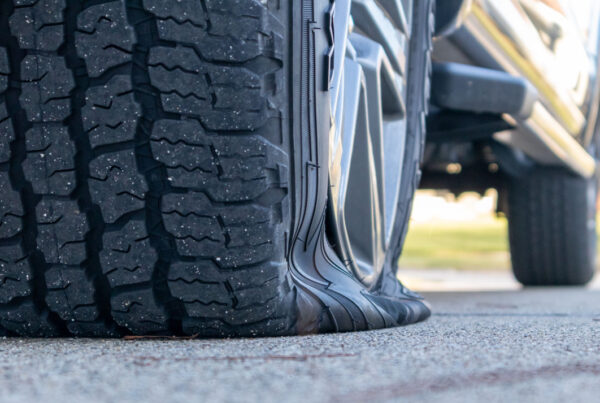
A deflated run-flat looks exactly like an inflated one. Michelin says it plainly: without a working tire pressure monitoring system, you may not even know you have had a pressure loss. Bridgestone states that all run-flat tires require TPMS, because without it a driver can keep rolling on an underinflated tire and accumulate hidden damage.
The mobility clock, whether it is 50 miles or something else for your tire, starts the moment the air leaves. On a conventional tire your eyes and the steering tell you. On a run-flat, the warning light is the only thing that tells you. A dead sensor on one of these cars is not a nuisance light. It is a missing gauge on the one system you cannot see.
Sensors are wear items, not permanent hardware, and coastal Sussex County is a hard place to be one. Salt-laden air off the Indian River Bay, salt spray and brake dust all work on the metal valve stems and the small seals, nuts and caps that go with them. That is the same hardware corrosion we see eating wheels and valve stems near the water, and it quietly ends a sensor’s life. Whenever a tire comes off the wheel in our Millsboro shop, that hardware gets a look as a matter of course.
Making the Call
There is no universally right answer, only the right answer for how you drive.
- You value not being stranded above all else. Stay on run-flats. That is the trade the design was built to make.
- The ride bothers you and it is your daily driver. Conventional tires are worth a serious look, paired with a plan for what you carry.
- The car sits for long stretches at a beach place in Lewes or Rehoboth. Either path works, but the TPMS conversation matters more, because a slow leak that starts while the car is parked is the one nobody notices.
- You want a specific tire that is not offered as a run-flat. A real reason to convert, provided the size, load rating and speed rating are correct for your vehicle.
- You are not sure which tires are on the car right now. Start there.
Cost is going to factor into this, and it should. But tire pricing moves constantly with model, size and availability, so a number written in a blog post is worse than no number at all. Bring the vehicle by, call us, or request a current quote on both paths so you are comparing real figures for your exact size.
Talk It Through With Your Local Tire Shop in Millsboro DE
Run flat tires Millsboro DE drivers rely on are worth understanding before the tires are worn out, not after. If you have been searching for a tire shop near you that will explain the trade instead of just quoting four tires, that is the conversation we like having. Maybe you are staying with run-flats. Maybe you are thinking about replacing run-flat tires with regular tires. Maybe you just want someone to confirm what is on the car and check your pressure sensors. We are happy to walk you through it with the wheels off.
We serve Millsboro, Long Neck, Dagsboro, Georgetown, Frankford, Lewes, Rehoboth Beach and the surrounding Sussex County area, along the Route 24 and Route 113 corridors.
Schedule an appointment and let’s figure out the right tire for the way you actually drive.